Frequently Asked Questions
When can I start taking driving lessons?
You can start learning to drive a car on public roads from the age of 17 if you hold a provisional driving licence. You can apply for your provisional licence when you are 15 years and 9 months old.
How do I get my provisional driving licence?
You must hold a provisional driving licence before you can start driving lessons. You can get your first provisional driving licence by applying to the DVLA online or by post. Get more information about provisional licence application process here.
Can I have a driving lesson without a provisional license?
You cannot start your driving lessons without a provisional licence. A provisional licence allows you the opportunity to start learning to drive a car. However, having a provisional licence does not allow you to practice without a driving instructor or someone else who fits legal criteria to supervise you when driving on the road.
How long does it take until I get my provisional licence?
Your provisional licence should arrive within 3 weeks of the date of application. Contact DVLA if it has not arrived by then.
What do driving instructors do?
Driving instructors teach people the skills and knowledge they need to drive safely and pass their driving test.
Can I have a driving lesson before I pass my theory test?
Yes – you can take practical lessons while preparing for your theory test. In fact, taking driving lessons whilst studying for the theory test is generally beneficial to the learning process.
Do I need driving lessons?
There are no legal requirements to take driving lessons prior to sitting driving test to gain a full licence. In practice, however, to meet the high standard required to pass a driving test it is highly recommended that you take professional tuition from a DVSA qualified driving instructor. The national standard for driving cars outlines what is required to do to pass the test. Best practice is to ensure that you can do everything without instruction.
How many driving lessons I need to take until I pass?
There are no minimum or maximum amount of hours tuition you must complete before you take a driving test. Everyone is different. According to DVSA statistics the average amount of lessons to be test ready varies on age.
Manual or automatic driving lessons?
Generally, you can pass a driving test in an automatic vehicle in less time that in a vehicle with manual transmission. This is primarily due to the fact that there is no clutch control required in an automatic. Also, if you have mobility issues, an automatic car can be a lot easier and more comfortable to drive.
A point to remember, however, that if you pass your test in an automatic car you will be restricted to driving automatic vehicles only. You can upgrade your licence to driving a manual vehicle at a later stage.
How many lessons a week should I take?
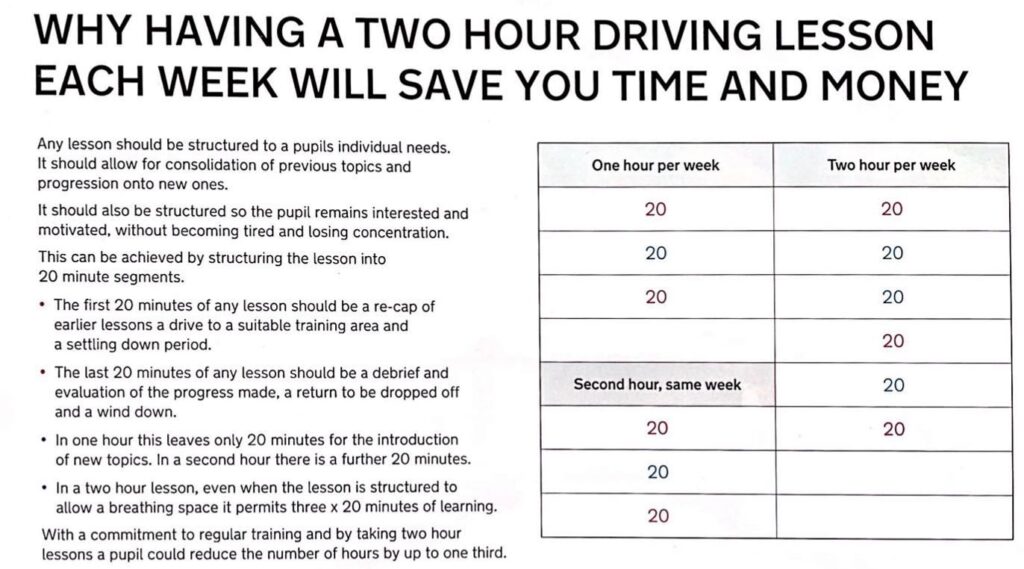
This is purely down to individual choice and financial circumstances. Best practice is to ensure continuity of driving lessons e.g. 2 hours per week. Ongoing progress should be regularly discussed with your driving instructor. (See Image Below).
Failed your driving test? What next?
So you’ve failed your driving test, now you’re desperately searching the internet for answers as to why and what the hell you’re meant to do next. Failure is not an easy thing to deal with, but it’s important to remember it’s a learning curve which you’re most definitely not experiencing alone. In this guide we’ll talk you through what you should be doing after failing your driving test, with some advice from our top driving instructors.
How many people fail their driving test first time?
Although you may feel alone in your failure, trust us when we say it’s more common than you think. In fact, according to the latest figures released by the Driver and Vehicle Standards Agency (DVSA), 53.3% of all people who took their practical driving test between March 2017 – July 2018 failed the test first time.
With driving test nerves and other drivers to contend with, it’s no surprise that over half of us are failing the test the first time around. So don’t beat yourself up about it, it’s said that those who don’t pass their test first time are better drivers anyway.
Why did I fail my driving test?
In order to improve you need to identify where you have gone wrong. Which is why it is so important to listen to the examiner’s feedback after they’ve uttered those earth-shattering words ‘you’ve failed’. In the moments following the end of the test they will provide crucial feedback on where you went wrong – perfect pointers on where to improve in your following driving lessons. At this point it is usually a good idea for your driving instructor to come and join you, so they can take in any information you may miss or forget – which can often happen after hearing bad news.
Minor and major faults and what they mean
Any fault could be a driving fault, serious fault or dangerous fault. The situation in which the fault occurs in, would dictate whether the fault is classed as a minor or major fault.
There are three types of faults:
- A dangerous fault includes anything which causes danger to you, the examiner, the public or property and is the most serious of all the faults. This is known as a major fault. So, for example, a pupil fails to check his exterior right door mirror before moving right around a parked car. But there is a motorbike close behind and the motorbike rider has to brake. This has caused another road user to take avoiding action and this would be assessed as a dangerous fault, or a major fault.
- A serious fault includes anything which could be potentially dangerous to you, the examiner, the public or property. A serious fault is also known as a major fault. In this example a pupil fails to check his exterior right door mirror before moving right around the same parked car, however this time there is a motorbike well behind. As the motorbike rider could be affected this would be assessed as a serious fault, or a major fault.
- A driving fault includes faults which are not potentially dangerous. These are known as minor faults in your test. If you repeatedly make the same fault it can become a serious fault. For this example, a pupil fails to check his exterior right door mirror before moving right around a parked car. But there is no other road user about that can be affected, so this is assessed as a driving fault, or a minor fault.
On the driving test a pupil can have 15 driving faults (minor faults) and still pass. However any serious or dangerous faults (major faults) would fail a pupil. An accumulation of driving faults (minor faults) in one area, i.e. checking mirrors before change of direction, would show there is a pattern developing in this area and sooner or later this will lead to the fault being serious or dangerous. Therefore this would be assessed as serious fault and lead to a fail.
The Day of Your Test
Test checklist
Bring your licence, Theory pass certificate, mask and anything else you think you need. Glasses? Water? Have something to eat beforehand!
We’ll wait by the car and the Examiner will come over to introduce themselves. They will ask you to sign the test agreement and check your licence.
You will be asked to read a number plate from a distance of around 20 metres.
You will be asked one ‘tell me’ question.
Examiner will explain how test works and what to expect.
The test will usually last 38-40 mins, and will feature 20 mins of independent driving using either a pre-programmed sat nav, or by following road signs.
The examiner will give you directions after that in the same way I have done on our lessons.
Expect up to 5 pull up on the left requests, where the examiner will be looking for how safely you can pull over and then re-join the flow of traffic.
You will be asked to perform one reversing manoeuvre. Either front bay park (reverse out), reverse bay park (at the test centre), reverse parallel park or pull up on the right and reverse 2 car lengths.
You may be asked to perform an emergency stop.
While driving, you will be asked to demonstrate one of the ‘show me’ questions.
The route will be designed to get you back to the Test Centre within the 40 minutes. If however, you commit a serious or dangerous fault, the Examiner will direct you straight back to the test centre.
At the end of the test, the examiner will give you the result, and a copy of the result will be emailed to you.
Useful tips-
Don’t second guess the result! What you think is a fail may not be in the examiner’s eyes.
Think safe! The examiner does not expect a perfect drive, but they do expect you to drive safely. Always ask yourself, ‘is what I’m about to do safe, and/or necessary? If the answer is no to either, don’t do it!
Observe, observe, observe! You can’t place too much emphasis on using mirrors and looking all around you on manoeuvres.
Don’t rush! Give yourself planning time, and don’t rush manoeuvres. Take time to safely readjust if you need to.
Remember, if you take a wrong turn, or get into the wrong lane, keep going the way it takes you. That’s always much safer than trying to correct it at the last minute.
Observe the speed limit at all times, but try to make reasonable progress when and if the road conditions allow.
This is YOUR test. If you need to take a 2 minute breather at any time, you are perfectly entitled to as long as you find somewhere safe, legal and convenient to stop.
Relax! Think of it as a lesson with a different Instructor. You are only being asked to show what you know.
Use the experience to improve your driving regardless of the outcome, and
GOOD LUCK!
In addition to what’s been said I also tell them 1. It’s an assessment of your skills not you as a person.
2. Drive how you drive on a lesson. Don’t change anything, otherwise what’s the point of paying for lessons!
3. You don’t need the licence you deserve it.